


Is Jensen Huang about to be fired? A week ago the question would have sounded absurd. Huang co-founded Nvidia in 1993, has run it ever since and built it into the most valuable chipmaker in the world. Then, on Sunday 8 November 2026, Nvidia’s board said it was opening an independent investigation into reports that its founder and chief executive had been the target of a foreign intelligence effort, and Huang told staff he had been unfaithful to his wife.
Since then the rumour mill has been running hot: will the Nvidia board fire its CEO, who could replace him, and what does it all mean for Nvidia shares? Below we separate what has actually been reported from the speculation, explain how a removal would work, and set out how we think about the risk as long-term investors.
The Nvidia board probe at a glance
NASDAQ: NVDA · Founder and CEO Jensen Huang · Position as at 12 November 2026
Sources: Nvidia board statement, Reuters, Bloomberg, ABC News and The New York Times as reported 8 to 11 November 2026. Figures are approximate.
What has actually happened
Late in October, The New York Times reported that US officials had examined a relationship between Jensen Huang and Alice Huang (no relation), a former executive at Megaspeed International. Megaspeed is a Singapore-based data centre operator that has bought billions of dollars of Nvidia chips, and US officials reportedly believe she was passing information to Beijing.
On 8 November Nvidia’s board said a committee of independent directors, assisted by outside counsel, would investigate reports that Huang had been the target of a foreign intelligence effort. In the same weekend Huang wrote to employees that he had been unfaithful to his wife, said he supported the review and would cooperate fully, and asked for privacy for his family.
It is just as important to note what has not happened. Neither Huang nor Alice Huang has been charged with anything. The board says it has no reason to believe US national security or Nvidia’s proprietary information was compromised. China’s embassy has called the claims groundless, Megaspeed has denied wrongdoing, and Singapore’s Ministry of Home Affairs has disputed reports that it investigated Alice Huang personally.
Is Jensen Huang going to be fired? Rumour versus record
Much of the “Jensen Huang fired” chatter online is commentary, not reporting. On the record, Nvidia has said the board has confidence in Huang and his leadership team, and a company spokesperson said he remains committed to leading Nvidia as CEO without interruption. There is no report that the board has discussed removing him.
The commentary is far less certain. Yale’s Jeffrey Sonnenfeld has put Huang’s chances of surviving at roughly even, and argued that any other Nvidia employee would lose their job over a similar episode. Georgetown ethicist Peter Jaworski has said the investigation’s findings should decide his fate. Investors and analysts on the other side point out that Nvidia has no obvious internal successor and that Huang is closely tied to its customer and supplier relationships.
How the Nvidia board could remove its CEO
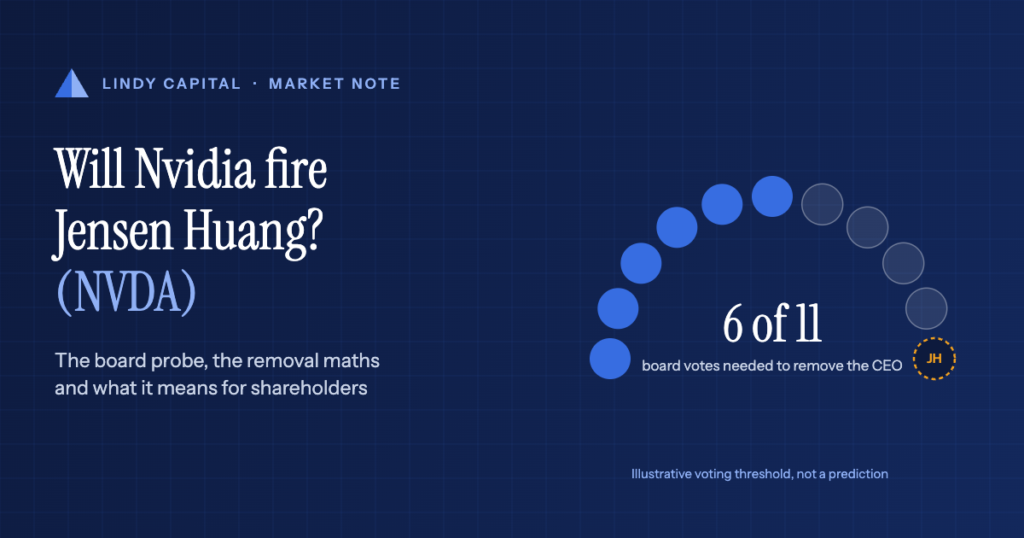
Mechanically, removing the CEO of Nvidia would be simple. Nvidia is a Delaware company with a single class of shares, and its board appoints and dismisses the chief executive. A simple majority of the 11 directors is enough. Unlike the founders of Meta or Alphabet, Huang has no super-voting shares that would let him block the board.
The removal maths: 6 of 11 votes
A simple majority of Nvidia’s 11 directors can dismiss the CEO. Huang holds one of the seats.
Illustrative only: it shows the voting threshold, not how any director would vote. Huang owns about 3.6% of Nvidia, making him its largest individual shareholder but well short of control.
In practice it is much harder. Several directors have sat alongside Huang for decades, including two who have been on the board since Nvidia was founded. Commentators have described the board as closely tied to its chief executive, and some have called Huang the AI industry’s first “too big to fail” executive.
What history says about boards and founder CEOs
Boards do remove powerful chief executives over personal conduct, but founders are a different case. The closest precedents show how varied the outcomes can be.
When boards have acted
Selected cases often cited in coverage of the Nvidia probe
| Company | Year | CEO | What happened |
|---|---|---|---|
| Intel | 2018 | Brian Krzanich | Left after failing to disclose a relationship with an employee |
| McDonald’s | 2019 | Steve Easterbrook | Fired over a relationship with an employee |
| OpenAI | 2023 | Sam Altman (co-founder) | Fired by the board, reinstated within days after staff revolted |
| Nvidia | 2026 | Jensen Huang (founder) | Board investigation under way; still CEO |
Neither Krzanich nor Easterbrook founded his company. The OpenAI case shows a board can act against a founder, and how quickly that can unravel.
What it means for Nvidia shares
The market’s first reaction was sharp. NVDA shares fell from a Friday close of US$186.64 to around US$172 to US$176 in early trading on Monday 9 November, and Bloomberg reported a fall of as much as 8.8% at one point, wiping close to US$400 billion off Nvidia’s value. It extended a sell-off in AI stocks from the previous week.
Rivals moved the other way. AMD rose about 9%, Broadcom about 7.5% and Marvell about 9%, which suggests investors treated this as a risk specific to Nvidia rather than to AI chips as a whole. Some market strategists argued the fall would have been far worse if investors genuinely expected Huang to go.
For anyone watching the Nvidia share price, the issue is key-person risk. Huang runs an unusually flat company in which dozens of executives report directly to him, and he is the face of Nvidia’s relationships with customers, suppliers and governments. Analysts at Citi have flagged risks to governance, regulation and export controls, and others have warned a prolonged review could slow decisions or product launches.
Both sides
The strongest arguments each way, based on what has been reported so far
Why he is likely to stay
- The board has publicly backed him and says nothing was compromised.
- No charges have been laid and key allegations are disputed.
- He is the company’s founder, largest individual shareholder and main strategist.
- There is no obvious internal successor.
- Political figures, including President Trump, have spoken in his support.
What could change that
- Investigation findings that information or chips were put at risk.
- Evidence he failed to disclose a conflict involving a major customer.
- Pressure from Congress, regulators or large institutional investors.
- A drawn-out review that starts to hurt execution or customer confidence.
- Reports that Nvidia intervened in a US export probe into Megaspeed.
General information only. This is not a forecast of the board’s decision.
Who is Jensen Huang, and why is he so hard to replace?
Jensen Huang is the Taiwanese-born American engineer who co-founded Nvidia with Chris Malachowsky and Curtis Priem in 1993 and has been its only chief executive. As the Nvidia founder, he steered the company from gaming graphics cards into the accelerated computing chips that now power most of the world’s AI data centres.
That is why so many analysts struggle to picture Nvidia without him. One commentator told Axios it was very hard to imagine anyone else running the company. Even critics who think he made a serious error tend to add that he is central to America’s AI ambitions.
Dates to watch
The timeline so far, and what comes next
Filled dots are past events; hollow dots are scheduled or requested
- Late October 2026The New York Times reports US officials examined Huang’s relationship with a Megaspeed executive
- 29 OctoberHuang tells Bloomberg Nvidia’s dealings with Megaspeed are normal and its chips were not illegally diverted
- 8 NovemberBoard opens an independent investigation; Huang admits the affair in an email to staff
- 9 NovemberNvidia shares fall as much as 8.8% during trading; rivals rally
- Around 17 NovemberNvidia’s quarterly results, as reported, the first test of management’s message
- 18 NovemberHouse committee chairs have asked Huang to attend a closed-door briefing
- To be confirmedFindings of the board’s independent investigation
Our view
We think the headlines run ahead of the facts. Today, Jensen Huang is still Nvidia’s CEO, his board has backed him in public, and no one has been charged. The question that matters for long-term shareholders is not the affair itself but whether the investigation finds that Nvidia’s information, chips or export compliance were put at risk. If it does, his position becomes far harder to defend. If it does not, this is more likely to be remembered as a governance scare than a turning point.
We also think the episode is a useful reminder of something investors in founder-led companies tend to forget when times are good: key-person risk is real, and it rarely shows up in a valuation model. We would watch three things from here: the tone of the coming results call, any change in Nvidia’s disclosure about succession planning, and what the independent directors eventually publish. A share price fall driven by uncertainty is not, on its own, a reason to buy or sell. For more of our thinking on AI and the companies behind it, see our Insights.
Frequently asked questions
Has Jensen Huang been fired by Nvidia?
No. As at 12 November 2026, Jensen Huang remains the Nvidia CEO. The board has opened an independent investigation and says it has confidence in his leadership.
Who is the CEO of Nvidia?
Jensen Huang, who co-founded the company in 1993 and has led it ever since.
Can the Nvidia board fire Jensen Huang?
Yes. A simple majority of Nvidia’s 11 directors can remove the chief executive, and Huang has no super-voting shares that would stop them.
Who owns Nvidia?
Nvidia is a public company owned by its shareholders, most of them large institutional investors. Huang owns about 3.6%, making him the largest individual shareholder.
Why did Nvidia shares fall?
Investors reacted to the board’s investigation and the uncertainty over whether Huang will remain in charge, as well as possible scrutiny from Congress and regulators.
Sources: Axios, ABC News, The Next Web (citing The New York Times and Bloomberg), Data Center Knowledge, Trending Topics, Beinsure. Information is current as at 12 November 2026 and may change as the investigation continues.