

Alphabet is the parent of Google. It earns most of its money from advertising beside search results and YouTube videos, and a growing share from renting computing power and AI models through Google Cloud. In the quarter to 30 June 2026 it reported revenue of US$119.8 billion, up 24% on a year earlier, with Google Cloud up 82%.
This study looks at the business the way we look at any company: durability first, numbers second, price last. It covers how Alphabet makes money, how strong its competitive position is, how it is funding a record investment programme in AI infrastructure, and what could go wrong. It ends with our fair value estimate, which is an opinion with stated assumptions. None of it is a recommendation.
Alphabet at a glance
NASDAQ: GOOGL · Mountain View, California · CEO Sundar Pichai (CEO since 2019) · Fiscal year ends 31 December
Figures as at 19 October 2026 unless stated. Sources are listed at the end of the article. Figures will date.
How we see the business, in one picture
Alphabet scores highly on moat and durability: Google Search has led its market for more than two decades and YouTube, Android and Chrome reach billions of people. We mark capital allocation and predictability lower because the company is spending at a pace without precedent in its history, has paused buybacks, issued new shares and borrowed heavily in 2026, and because reported profits now swing with the paper value of its stakes in other companies.
Lindy business profile: Alphabet
Our assessment of business characteristics, scored 1 to 5. Not a rating of the shares or a recommendation.
Each score is explained in the sections below.
What does Alphabet do?
Alphabet is a holding company created in 2015 to sit above Google and a set of smaller, longer-dated ventures. Almost all of its revenue comes from Google, which it reports in two segments: Google Services and Google Cloud. A third segment, Other Bets, holds early-stage projects such as Waymo, the self-driving car business.
In the June 2026 quarter, Google Services produced 79% of revenue and Google Cloud 21%. Other Bets and currency hedging made up less than 1%.
- Google Services. Search, YouTube, Android, Chrome, Maps, Gmail and Google Play, plus subscriptions such as YouTube Premium and Google One and devices such as Pixel phones. Revenue was US$94.5 billion in the June 2026 quarter, up 15%, with an operating margin of 41.8%.
- Google Cloud. Rents computing infrastructure, data storage, AI models (Gemini) and business software (Google Workspace) to companies and developers. Revenue was US$24.8 billion in the quarter, up 82%, with an operating margin of 35.6%.
- Other Bets. Waymo and other ventures. Revenue was US$0.4 billion in the quarter, with an operating loss of US$1.8 billion.
The mix is shifting quickly towards Cloud. A year earlier, Cloud was 14% of revenue and earned an operating margin of 20.7%; in the June 2026 quarter it was 21% of revenue at 35.6%. Search remains the single largest line, at US$63.3 billion or 53% of total revenue, and it is still growing, up 17% on a year earlier.
Where the revenue came from, quarter to 30 June 2026
Share of US$119.8B total revenue
Google Services includes search, YouTube ads, Google Network, subscriptions, platforms and devices. Other Bets revenue was US$382 million and hedging gains US$106 million. Source: Alphabet Q2 2026 earnings release (Form 8-K, exhibit 99.1).
How fast Alphabet is growing
Revenue grew from US$161.9 billion in 2019 to US$402.8 billion in 2025, a compound rate of about 16% a year. That is unusual for a company of this size and came from three sources: more search advertising, YouTube, and the rise of Google Cloud.
Growth has accelerated in 2026. Revenue rose 22% in the March quarter and 24% in the June quarter. Analysts surveyed by S&P Global expect revenue of about US$499.6 billion for 2026, which would be growth of 24%. That estimate is a consensus forecast, not company guidance; Alphabet does not give revenue guidance.
Alphabet annual revenue
US$ billions, fiscal years ending 31 December
Source: Alphabet earnings releases and StockAnalysis. FY26 is an analyst estimate, not company guidance.
View the data
| Revenue | |
|---|---|
| FY19 | 162 |
| FY20 | 183 |
| FY21 | 258 |
| FY22 | 283 |
| FY23 | 307 |
| FY24 | 350 |
| FY25 | 403 |
| FY26 est (estimate) | 500 |
The cloud business
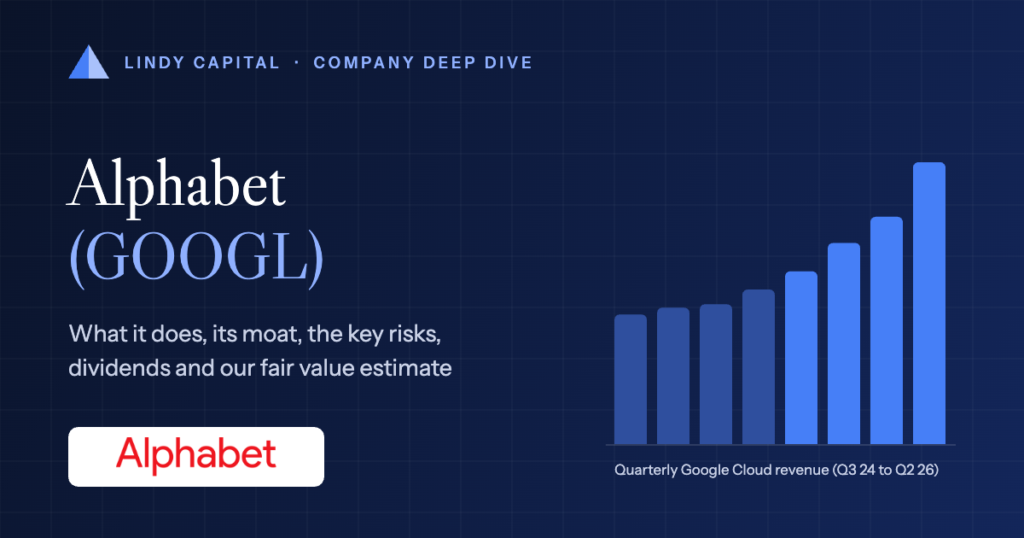
Google Cloud is now the main source of Alphabet’s growth. Quarterly revenue more than doubled in under two years, from US$11.4 billion in the September 2024 quarter to US$24.8 billion in the June 2026 quarter, and year-on-year growth sped up from 63% in the March 2026 quarter to 82% in the June quarter.
Demand is being driven by AI. Companies rent Google’s chips (including its own tensor processing units, or TPUs) and models to train and run AI systems. Anthropic, in which Google is also an investor, has committed to buy at least five gigawatts of computing capacity from Google Cloud.
The backlog, meaning contracted revenue not yet recognised, reached US$513.9 billion at 30 June 2026, about 6.6 times Cloud’s revenue over the past four quarters. Alphabet expects to recognise just over half of it within 24 months. Profitability has improved sharply too: Cloud’s operating margin rose from 20.7% to 35.6% in a year.
Quarterly Google Cloud revenue
US$ billions
Source: Alphabet quarterly earnings releases (Form 8-K, exhibit 99.1).
View the data
| Value | |
|---|---|
| Q3 24 | 11.4 |
| Q4 24 | 12.0 |
| Q1 25 | 12.3 |
| Q2 25 | 13.6 |
| Q3 25 | 15.2 |
| Q4 25 | 17.7 |
| Q1 26 | 20.0 |
| Q2 26 | 24.8 |
How Alphabet makes money
Search advertising. Advertisers bid to appear beside search results and pay mainly when someone clicks. Google Search and other brought in US$63.3 billion in the June 2026 quarter, up 17%. Alphabet says AI Mode in Search has passed one billion monthly users.
YouTube advertising. Ads shown before and during videos and on YouTube Shorts earned US$11.1 billion in the quarter, up 13%.
Subscriptions, platforms and devices. YouTube Premium and TV, Google One storage, Google Play app store fees and Pixel hardware earned US$12.9 billion, up 15%.
Google Cloud. Usage-based and contracted fees for computing, storage, AI models and Workspace software earned US$24.8 billion, up 82%.
Google Network. Ads Google places on other websites and apps earned US$7.3 billion, down 1%. This is the lowest-margin part of the ad business and is shrinking.
The moat: where the advantage comes from
A moat is what stops competitors taking a company’s profits. Alphabet’s moat rests on scale, data and habit: billions of people start their day on Google products, and that audience is what advertisers pay for.
Sources of competitive advantage
Our assessment of which classic moat sources apply to Alphabet
| Moat source | Applies? | Where it shows up |
|---|---|---|
| Switching costs | Partial | Low for search users, who can change engine in seconds; higher for Cloud and Workspace customers whose systems and data are built around Google |
| Intangible assets | Strong | The Google, YouTube, Android and Chrome brands; research leadership in AI through Google DeepMind; custom TPU chip designs |
| Network effects | Strong | More users bring more advertisers and more data to improve results; YouTube creators and viewers attract each other; Android links app developers and phone makers |
| Cost advantage and scale | Strong | Its own data centres, chips and subsea cables let it run search and AI more cheaply than most rivals; very few firms can spend US$195 billion to US$205 billion a year on capex |
| Efficient scale | Limited | Search and cloud markets are open to competition; scale helps but does not lock rivals out |
The moat is wide, but the ground under it is moving. AI chat assistants offer a new way to find information that does not run through a page of search ads. So far Alphabet has adapted well, and search revenue is growing faster than it did a year ago. The real test is whether answers delivered by AI can be monetised as well as the traditional results page, over many years.
Customers and competition
Alphabet competes on several fronts, each with well-funded rivals.
- Microsoft competes in cloud through Azure, in search through Bing, in office software against Workspace, and in AI through its partnership with OpenAI.
- Meta competes for advertising budgets through Facebook, Instagram and WhatsApp, and for user attention against YouTube.
- Amazon is the largest cloud provider through Amazon Web Services and a fast-growing advertising business, especially for product searches.
- OpenAI and other AI labs offer chat assistants that answer questions directly and may take some of the queries that once went to Google Search.
- Regulators are not competitors but shape the field. In the US, courts have found that Google held illegal monopolies in search and in parts of advertising technology; remedies are under appeal.
How Alphabet compares with its peers
Microsoft and Meta are the closest listed comparisons: both are large, profitable technology platforms that sell advertising or cloud services and are spending heavily on AI. Figures are from StockAnalysis at the close on 19 October 2026.
Alphabet against its closest listed peers
Figures at the close on 19 October 2026. GAAP margins unless stated; forward P/E uses analysts’ next-year earnings estimates.
| Measure | Alphabet GOOGL | Microsoft MSFT | Meta META |
|---|---|---|---|
| Market value | US$4.21T | US$3.96T | US$1.80T |
| Revenue, last 12 months | US$445.9B | US$331.8B | US$228.3B |
| Gross margin | 60.9% | 67.9% | 81.8% |
| Operating margin (GAAP) | 33.1% | 46.8% | 38.1% |
| Free cash flow margin | 11.9% | 20.2% | 18.0% |
| Return on invested capital | 24.9% | 26.2% | 25.4% |
| Net cash (net debt) | US$121.7B | (US$52.0B) | (US$22.1B) |
| Forward P/E | 25.8x | 27.0x | 22.2x |
| PEG ratio | 1.86 | 1.71 | 1.12 |
| Dividend yield | 0.26% | 0.73% | 0.30% |
Valuation multiples and market values move with share prices and are shown at the date above. Source: StockAnalysis unless stated.
Alphabet is the largest of the three by market value and revenue, and the only one with net cash, helped by the shares, preferred stock and bonds it sold in 2026. It has the lowest margins at every level: gross margin is pulled down by Cloud and hardware, and its free cash flow margin of 11.9% is the lowest because its capex has grown fastest. On forward earnings it sits between Meta, the cheapest, and Microsoft, and it has the highest PEG ratio of the three, meaning investors are paying the most per unit of expected growth.
Durability: the Lindy test
The Lindy effect says that the longer something has survived, the longer it is likely to keep surviving. Google has led web search since the early 2000s, through the shift from desktop to mobile and the rise of social media. That is a long record, though the AI shift is the biggest challenge to its core product since it began.
Key moments in Alphabet’s history
- 1998 · Google is incorporated on 4 September by Larry Page and Sergey Brin.
- 2000 · Begins selling text ads linked to search keywords, the model that still funds the company.
- 2004 · Lists on the NASDAQ on 19 August and launches Gmail.
- 2006 · Completes the purchase of YouTube for US$1.65 billion.
- 2008 · Launches the Chrome browser; the first Android phone is announced.
- 2015 · Restructures into Alphabet, with Google as its largest subsidiary.
- 2019 · Sundar Pichai becomes CEO of Alphabet as well as Google.
- 2024 · Announces its first-ever dividend.
- 2026 · Completes the US$32 billion purchase of cloud security firm Wiz; raises 2026 capex plan to US$195 billion to US$205 billion.
Search, YouTube and Android pass the Lindy test comfortably. Google Cloud is younger and its AI-driven growth is only a few years old, so its durability is less proven. We score durability at 4 out of 5 rather than 5 because the habit that sustains search, typing a question into a box, is now being challenged by a different kind of product.
Profitability and cash flow
Alphabet’s operating margin has widened from 26.5% in 2022 to 33.1% over the past four quarters, as Cloud moved from losses to strong profits and costs were held down. In the June 2026 quarter, operating income was US$40.8 billion, a 34% margin.
Reported net income is now far higher than operating profit suggests. In the June quarter Alphabet booked a US$99.0 billion gain on equity securities, mainly from the rising value of stakes in Anthropic and SpaceX. That added US$6.26 of the US$9.11 diluted earnings per share. These are mostly unrealised paper gains: they do not bring in cash and can reverse.
Free cash flow tells a different story. Capital spending doubled to US$44.9 billion in the June quarter, and free cash flow was negative US$5.9 billion. Over the past four quarters, free cash flow was US$53.3 billion, down from US$73.3 billion in 2025, after US$132.4 billion of capex.
Annual free cash flow
US$ billions
US$ billions. Free cash flow is operating cash flow minus purchases of property and equipment, as Alphabet defines it. Sources: Alphabet earnings releases and StockAnalysis.
View the data
| Value | |
|---|---|
| FY19 | 31.0 |
| FY20 | 42.8 |
| FY21 | 67.0 |
| FY22 | 60.0 |
| FY23 | 69.5 |
| FY24 | 72.8 |
| FY25 | 73.3 |
| TTM Jun 26 | 53.3 |
The gap between record reported profit and falling free cash flow is the central issue for anyone studying Alphabet today. Management plans to spend US$195 billion to US$205 billion on capex in 2026 and says spending will rise significantly again in 2027. Those data centres will be depreciated over the coming years, which will weigh on reported operating margins even if the investment pays off.
Financial health: debt and cash
Alphabet still has more cash than debt. At 30 June 2026 it held US$242.5 billion in cash and marketable securities against long-term debt of US$98.2 billion. StockAnalysis puts total debt, including leases, at US$120.8 billion and net cash at US$121.7 billion.
The balance sheet has changed quickly. Long-term debt was US$10.9 billion at the end of 2024. In the first half of 2026 alone, Alphabet raised US$56.2 billion from debt, US$30.5 billion from new common shares and US$19.1 billion from mandatory convertible preferred stock, which carries a 6.25% dividend and converts into shares in 2029.
Long-term debt and cash at each quarter end
US$ billions
US$ billions. Cash includes cash equivalents and marketable securities. Debt is long-term debt as reported. Source: Alphabet earnings releases and Q2 2026 Form 10-Q.
View the data
| Debt | Cash | |
|---|---|---|
| Dec 2024 | 10.9 | 95.7 |
| Sep 2025 | 21.6 | 98.5 |
| Dec 2025 | 46.5 | 126.8 |
| Mar 2026 | 77.5 | 126.8 |
| Jun 2026 | 98.2 | 242.5 |
Alphabet’s finances remain strong, but the direction matters. A company that once funded everything from its own cash flow is now raising outside capital to keep up with AI demand. That is a reasonable choice if the returns come, and it is a new source of risk if they do not.
Capital allocation and management
Sundar Pichai has run Google since 2015 and Alphabet since 2019, and Anat Ashkenazi is chief financial officer. Over 2024 and 2025 Alphabet returned large sums to shareholders, buying back US$62.2 billion and US$45.7 billion of shares, and it began paying a dividend in 2024.
In 2026 the priority shifted firmly to investment. Alphabet bought no shares back in the first half, issued 142 million new common shares and sold convertible preferred stock, and its diluted share count rose from 12.20 billion to 12.31 billion over the year to June. It also completed the US$32 billion purchase of Wiz. Its stakes in Anthropic and SpaceX have proved valuable on paper, but they also create a loop in which Google invests in a customer that then spends heavily on Google Cloud.
Dividends: rate, history and growth
Alphabet began paying a quarterly dividend in 2024. It is small relative to the share price and to the company’s cash flow, and it has been raised each year since.
Dividend at a glance
Share price as at 18 November 2026, refreshed daily
The dividend per share went from US$0.60 in 2024, a partial year of three payments, to US$0.83 in 2025. The April 2026 rise was smaller, at 4.8%. Dividends took 13.7% of free cash flow in 2025, but in the first half of 2026 dividends paid of US$5.2 billion were higher than free cash flow of US$4.3 billion, as capex surged.
Dividends per share
US$ per share, by fiscal year
FY24 includes three quarterly payments; FY25 four. The figure beside FY25 is growth on FY24 in per cent. Current annual rate is US$0.88. Source: StockAnalysis. Bottom row: increase on the previous year.
View the data
| Dividend per share (US$) | |
|---|---|
| FY24 | $0.60 |
| FY25 | $0.83 |
Dividends paid and free cash flow
US$ billions
US$ billions. H1 26 is the six months to 30 June 2026. Sources: Alphabet earnings releases and Q2 2026 Form 10-Q.
View the data
| Dividends paid | Free cash flow | |
|---|---|---|
| FY24 | 7.4 | 72.8 |
| FY25 | 10.0 | 73.3 |
| H1 26 | 5.2 | 4.3 |
The dividend costs about US$10 billion a year, which Alphabet can easily cover from its cash and borrowing capacity. Growth in the dividend, however, now depends on capex settling down and free cash flow recovering.
Strengths and risks at a glance
What stands out
Our checklist of the business’s main strengths and risks
Strengths
- Google Search remains the default way billions of people look for information, and search revenue grew 17% in the June 2026 quarter.
- Google Cloud is growing fast and profitably: revenue up 82% with a 35.6% operating margin and a US$513.9 billion backlog.
- Deep AI capability across research (Google DeepMind), its own chips (TPUs), models (Gemini) and distribution through Search, Android and YouTube.
- Net cash of about US$121.7 billion and very large operating cash flow give it room to invest through a downturn.
- Valuable stakes in Anthropic and SpaceX that are not reflected in operating earnings.
Risks
- Capex of US$195 billion to US$205 billion in 2026, rising again in 2027, may earn lower returns than past investments; free cash flow has already fallen.
- AI assistants could erode search queries or the price advertisers will pay for AI-generated answers.
- US antitrust remedies in search and ad tech, and EU actions, could limit default deals, data use or business practices; appeals are pending.
- Reported earnings now swing with paper gains on equity stakes, and part of Cloud demand comes from Anthropic, a company Google has invested in.
- Shareholders are being diluted by new share issues and convertible preferred stock, reversing years of buybacks.
The case for and against the business
Both sides
The strongest arguments we can make each way about the business
The case for
Alphabet owns the world’s leading search engine and video platform, and it has built one of the few cloud and AI businesses able to serve demand at global scale. Cloud’s backlog suggests years of contracted growth. If the AI investment earns returns anything like Google’s past investments, earnings could keep compounding from an already very large base, and the balance sheet can carry the build-out.
The case against
The business is in the middle of a very expensive bet with an uncertain payoff. Free cash flow has fallen, the company is borrowing and issuing shares, and record profits are mostly paper gains on private and newly listed stakes. Search faces its first serious substitute in decades, and courts have found Google acted illegally to protect its position. At about 23 times analysts’ 2027 earnings estimate, the share price already assumes much of the AI spending works.
Our fair value estimate for Alphabet
We value Alphabet on its future earnings. We take analysts’ consensus earnings per share for 2027 of US$15.25 (an adjusted figure that excludes gains on equity investments), apply a haircut for the risks set out above, multiply by a price-to-earnings (P/E) multiple, and discount the result back to today at 10% a year over about one year.
Our base case uses a 10% haircut, giving 2027 earnings of US$13.73 per share, and a P/E of 22, which gives a fair value of about US$275 per share. The bear case cuts earnings by 20% and applies a P/E of 16, for about US$178. The bull case takes the consensus in full at a P/E of 28, for about US$388. The share price at the close on 19 October 2026 was US$344.18, above our base case and below our bull case. This is our estimate and may prove wrong.
Lindy Capital fair value estimate · Alphabet Inc.
Close to our estimate
The share price is within 20% of our fair value estimate (2% above). Shaded bands sit 20% either side of our base-case estimate; the striped strip shows the range of our scenarios.
| Scenario | FY2027 EPS | P/E applied | Fair value today |
|---|---|---|---|
| Bear: consensus less 20% | US$12.20 | 16x | US$178 |
| Base: consensus less 10% | US$13.73 | 22x | US$275 |
| Bull: consensus in full | US$15.25 | 28x | US$388 |
Fair value = FY2027 EPS (S&P Global consensus via StockAnalysis, less a haircut) × P/E, discounted one year at 10%; no value is added for equity stakes or net cash.
Two traps when valuing Alphabet
Reported earnings are inflated by paper gains. Trailing GAAP earnings of US$19.93 a share make the P/E look like 17, but most of the recent profit came from revaluing stakes in Anthropic and SpaceX. Valuing Alphabet on that number would overstate what the operating business earns.
Capex hides future costs, and stakes hide value. Today’s capex becomes tomorrow’s depreciation, so margins may fall even if revenue keeps climbing. At the same time, our method ignores the equity portfolio, including non-marketable securities of US$131.5 billion at 30 June 2026, so the estimate leaves out a real, if volatile, source of value.
Share price vs our fair value estimate
Weekly closing price over two years, with each fair value estimate from the date we published it. The shaded band is our bear-to-bull range.
First estimate published 23 October 2026. The dashed line shows the estimate in force; until we revise it, it is drawn across the whole period for comparison. Latest weekly price US$281.45. Prices from Yahoo Finance, refreshed daily. The estimate changes only when we revise it.
What we would watch
- Google Cloud growth and margin, and how quickly the US$513.9 billion backlog turns into revenue.
- Capex against guidance of US$195 billion to US$205 billion for 2026, and the first figures for 2027.
- Search revenue growth as AI Mode and Gemini change how people search.
- Outcomes of the US search and ad tech appeals and EU actions.
- Whether buybacks resume and the share count stops rising.
The short version
Alphabet is one of the most durable businesses in the world, built on search habits formed over more than 25 years. It is now spending on AI at a scale that is reshaping its cash flow and balance sheet, and its reported profits are swollen by gains on its investments. On our conservative assumptions, the share price sits above our base case fair value estimate. The next two years of Cloud growth and capex returns will show whether that gap was caution or the market seeing further.
Frequently asked questions
What does Alphabet do?
Alphabet is the parent of Google. It earns most of its revenue from advertising on Google Search and YouTube, and a fast-growing share from Google Cloud, which rents computing power, AI models and business software.
How big is Google Cloud?
Google Cloud earned US$24.8 billion in the quarter to 30 June 2026, about 21% of Alphabet’s revenue, up 82% on a year earlier. It had a contracted backlog of US$513.9 billion.
Why did Alphabet’s profit jump in 2026?
Mostly because of unrealised gains on its stakes in other companies, chiefly Anthropic and SpaceX. In the June 2026 quarter these gains added US$6.26 to diluted earnings per share of US$9.11.
Does Alphabet pay a dividend?
Yes. It has paid a quarterly dividend since 2024. The current rate is US$0.22 a share each quarter, or US$0.88 a year.
Is Alphabet a buy?
We don’t make buy or sell recommendations. Our fair value estimate, set out above with its assumptions, is our opinion of what the business may be worth, not advice. Whether any investment suits you depends on your own circumstances, so speak to a licensed financial adviser.
Sources
- Alphabet Q2 2026 earnings release (Form 8-K, exhibit 99.1)
- Alphabet Q1 2026 earnings release (Form 8-K, exhibit 99.1)
- Alphabet Q4 and FY2025 earnings release
- Alphabet Q3 2025 earnings release (Form 8-K, exhibit 99.1)
- Alphabet Q4 and FY2024 earnings release (Form 8-K, exhibit 99.1)
- Alphabet Q4 and FY2020 earnings release (Form 8-K, exhibit 99.1)
- Alphabet Form 10-Q, quarter to 30 June 2026
- Alphabet Form 8-K, mandatory convertible preferred stock, June 2026
- Nasdaq: Alphabet Q2 earnings call highlights
- Fortune: Anthropic and SpaceX investments lift Google earnings
- PYMNTS: Google ad tech remedy ruling
- Impact: US appeals remedies in Google search case
- ITdaily: Google completes Wiz acquisition
- StockAnalysis: GOOGL statistics
- StockAnalysis: GOOGL forecast
- StockAnalysis: GOOGL dividend
- StockAnalysis: GOOGL financials
- StockAnalysis: MSFT statistics
- StockAnalysis: META statistics
- Wikipedia: History of Google
- Wikipedia: Alphabet Inc.
- Wikipedia: YouTube
- Wikipedia: Android (operating system)
Disclosure: Lindy Capital may hold, buy or sell shares in Alphabet (GOOGL) at any time, without notice, and does not disclose its positions. This is a study of how a business works, not a recommendation to buy, sell or hold any security. Our fair value estimate is an opinion based on the assumptions stated with it, not a price target or a forecast of the share price. Company guidance and analysts’ estimates are shown as reported. Figures are from public filings and data providers and will date. Important information.