

SpaceX listed on Nasdaq in June 2026 in the largest initial public offering on record, raising about US$86 billion including the underwriters’ extra shares. It is three businesses under one roof: the world’s busiest rocket launcher, the Starlink satellite internet service, and, since February 2026, Elon Musk’s artificial intelligence company xAI, which also owns the social network X.
The company is 24 years old but has only about four months of public trading and two quarterly reports as a listed company, so much of what we know comes from its prospectus. This study looks at how each part makes money, how durable it is, and what the balance sheet can carry. It ends with our fair value estimate, none of which is a recommendation.
SpaceX at a glance
NASDAQ: SPCX · Starbase, Texas · CEO Elon Musk (founder, CEO and chairman since 2002) · Fiscal year ends 31 December
Figures as at 23 October 2026 unless stated. Sources are listed at the end of the article. Figures will date.
How we see the business, in one picture
Our assessment of business characteristics, scored 1 to 5. It is a profile of the business, not a rating of the shares. SpaceX scores well on competitive position in launch and satellite internet, but less well on predictability and capital allocation, because the newly merged AI business is consuming most of the company’s capital and its results are hard to forecast.
Lindy business profile: SpaceX
Our assessment of business characteristics, scored 1 to 5. Not a rating of the shares or a recommendation.
Each score is explained in the sections below.
What does SpaceX do?
SpaceX was founded by Elon Musk in 2002 to cut the cost of reaching space. It designs, builds and flies its own rockets and spacecraft, and it reuses the first stage of its Falcon 9 rocket, which lands back on Earth after launch. By 31 March 2026 it had completed about 650 orbital launches.
Those cheap, frequent launches let SpaceX build Starlink, a network of roughly 10,200 satellites in low Earth orbit that sells internet access to homes, ships, aircraft, businesses and governments. In February 2026 SpaceX acquired X.AI Holdings, the owner of the Grok AI models and the X social network, and it now reports three segments.
- Connectivity. Starlink broadband for consumers, enterprises and governments, plus Starlink Mobile, which connects ordinary phones directly to satellites. US$5.2 billion of revenue in the September quarter.
- Super Intelligence (formerly AI). Grok, the X platform’s advertising and subscriptions, the Cursor AI coding tools acquired in August, and cloud services that rent the company’s Colossus data-centre computing to other AI developers. US$7.6 billion of revenue in the September quarter.
- Space. Launch services for commercial and government customers, crew and cargo flights to the International Space Station for NASA, and development of the giant Starship rocket. US$1.8 billion of revenue in the September quarter.
The mix is shifting fast. Connectivity was 61% of revenue in 2025, but revenue in the Super Intelligence segment, previously reported as AI, nearly tripled between the June and September quarters as cloud-computing contracts ramped up, and it is now more than half of the total. SpaceX completed an all-stock purchase of the AI coding company Cursor, valued at US$60 billion, on 14 August 2026, and Cursor contributed US$608 million of revenue in the September quarter.
Where the revenue came from, quarter to 30 September 2026
Share of US$14.6B total revenue
Segment revenue of US$5,248M, US$7,560M and US$1,767M sums to total revenue of US$14,575M. Super Intelligence was previously reported as the AI segment. Source: SpaceX Q3 2026 results release.
How fast SpaceX is growing
Revenue grew about 35% in 2024 and 33% in 2025, reaching US$18.7 billion. These figures include xAI and X, because SpaceX accounted for the xAI deal as a merger of companies under Musk’s common control and restated earlier years.
Growth then accelerated sharply. Revenue rose 92% in the June quarter and 161% in the September quarter, to US$14.6 billion, driven by Starlink subscriber growth and new AI cloud-services contracts. Revenue for the first nine months of 2026 was US$27.1 billion. Analysts’ average estimate for the full year is US$45.2 billion, which would be growth of about 142%, and management has guided to US$33 billion to US$37 billion for the March 2027 quarter alone. Those figures depend heavily on AI computing contracts that began only this year.
SpaceX annual revenue
US$ billions, fiscal years ending 31 December
Includes xAI and X as restated by SpaceX. Sources: SpaceX prospectus, StockAnalysis (financials and forecast, viewed 23 October 2026).
View the data
| Revenue | |
|---|---|
| FY23 | 10.4 |
| FY24 | 14.0 |
| FY25 | 18.7 |
| FY26 est (estimate) | 45.2 |
Starlink: the profit engine
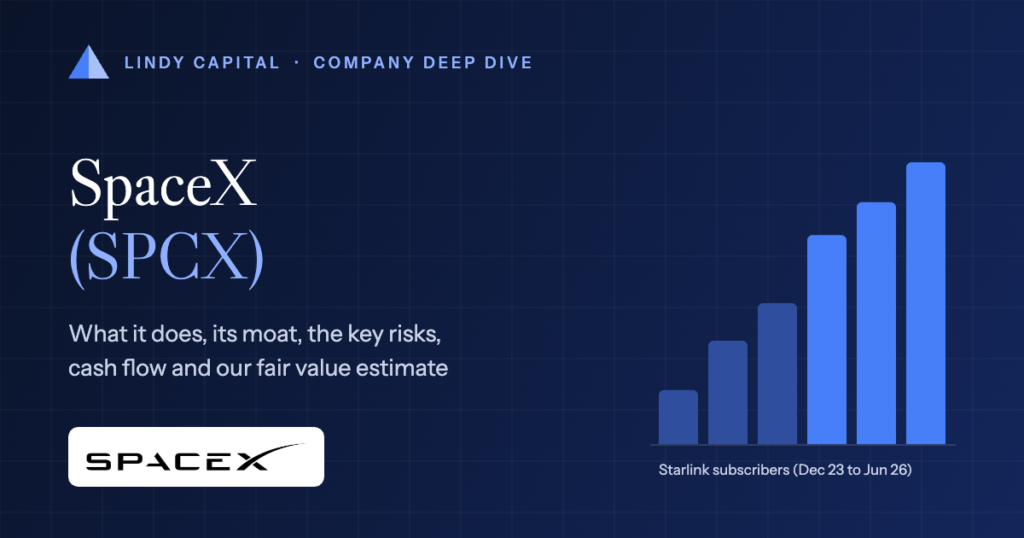
Starlink is the part of SpaceX that already earns money. Subscribers grew from 2.3 million at the end of 2023 to 13.6 million at 30 September 2026, and the company added about 1.6 million in the September quarter. Connectivity earned an operating profit of US$2.4 billion on US$5.2 billion of revenue in that quarter, a margin of about 45%, helped by a one-time benefit, mainly tariff refunds, that management put at about 3 percentage points of gross margin.
Growth has come with lower prices per customer. Average revenue per user fell from US$99 a month in 2023 to US$66 in the March and June quarters of 2026, before edging up to US$69 in the September quarter, as Starlink pushed into cheaper plans and lower-income markets. More customers at lower prices can still be a good trade, but it means subscriber numbers overstate revenue growth.
Starlink subscribers
Millions, at period end
Sources: SpaceX prospectus (via Via Satellite and Hargreaves Lansdown coverage) and SpaceX Q2 and Q3 2026 results releases.
View the data
| Value | |
|---|---|
| Dec 23 | 2.3 |
| Dec 24 | 4.4 |
| Jun 25 | 6.0 |
| Sep 25 | 7.2 |
| Dec 25 | 8.9 |
| Mar 26 | 10.3 |
| Jun 26 | 12.0 |
| Sep 26 | 13.6 |
How SpaceX makes money
Starlink subscriptions. Monthly fees from about 13.6 million subscribers in 174 markets, plus terminal sales, enterprise contracts for airlines and ships, and government work. The September-quarter Adjusted EBITDA margin for Connectivity was about 67%, including a one-time benefit.
Government contracts. NASA crew and cargo flights, national security launches (SpaceX flew 11 of 12 such medium and heavy missions in 2025) and Starshield, a version of Starlink for government use, where SpaceX won more than US$6 billion of multi-year US contracts.
AI cloud services. Renting computing capacity in the Colossus data centres to other AI developers. Cloud services drove most of the US$7.0 billion of Super Intelligence solutions and infrastructure revenue in the September quarter, and the prospectus discloses that Anthropic will pay US$1.25 billion a month through 2029.
Advertising and subscriptions on X and Grok. The legacy X advertising business and consumer and business subscriptions to Grok. Advertising brought in US$538 million in the September quarter.
Commercial launch. Selling Falcon 9 and Falcon Heavy launches to satellite operators. Most launches now carry SpaceX’s own Starlink satellites: 23 of 35 launches in the September quarter were internal.
The moat: where the advantage comes from
SpaceX’s advantage starts with reusable rockets. Because it lands and reflies Falcon 9 boosters, it can launch more often and more cheaply than anyone else, and it uses that cheap access to orbit to build and replace the Starlink network faster than rivals can. The AI business has no comparable advantage yet.
Sources of competitive advantage
Our assessment of which classic moat sources apply to SpaceX
| Moat source | Applies? | Where it shows up |
|---|---|---|
| Switching costs | Partial | Starlink users can leave, but governments and enterprises build systems around it |
| Intangible assets | Strong | Spectrum licences, launch licences, NASA and defence certifications, and two decades of flight data |
| Network effects | Limited | Some on X; Starlink gains from scale rather than from users attracting users |
| Cost advantage and scale | Strong | Reusable boosters, in-house satellite factory and about 10,200 satellites in orbit |
| Efficient scale | Partial | Few orbital launchers can win national security missions; low orbit space and spectrum are finite |
The moat is real in launch and satellite internet but rests on continued engineering success, especially Starship, which the company needs to launch larger next-generation satellites. In AI, SpaceX competes with far larger and more established model developers and cloud providers, and its position there depends on how much it is willing to spend.
Customers and competition
SpaceX faces different competitors in each segment, and in AI they are among the largest companies in the world.
- Launch: Rocket Lab, Blue Origin, United Launch Alliance and state-backed launchers in Europe and China. None yet matches SpaceX’s launch rate.
- Satellite internet: Amazon’s Project Kuiper, OneWeb (Eutelsat) and Chinese constellations, plus traditional satellite operators.
- Direct-to-phone service: AST SpaceMobile and partnerships between mobile carriers and other satellite operators.
- AI models and cloud: OpenAI, Anthropic (also a SpaceX cloud customer), Google, Meta and the large cloud providers.
How SpaceX compares with its peers
No listed company does everything SpaceX does. We compare it with Rocket Lab, the nearest listed launch and spacecraft company, and AST SpaceMobile, which is building a satellite network that connects directly to ordinary mobile phones, the same market as Starlink Mobile. Both are earlier-stage and loss-making, which makes them fair comparisons for a business still investing heavily.
SpaceX against its closest listed peers
Figures at the close on 23 October 2026. GAAP margins unless stated; forward P/E uses analysts’ next-year earnings estimates.
| Measure | SpaceX SPCX | Rocket Lab RKLB | AST SpaceMobile ASTS |
|---|---|---|---|
| Market value | US$2.00T | US$31.5B | US$15.3B |
| Revenue, last 12 months | US$32.0B | US$0.8B | US$0.1B |
| Gross margin | 56.8% | 37.3% | 38.9% |
| Operating margin (GAAP) | 1.8% | -27.6% | -410.3% |
| Free cash flow margin | -123% | -48% | Not meaningful |
| Return on invested capital | n/a | -5.5% | -8.4% |
| Net cash (net debt) | US$50.6B | US$2.3B | (US$0.7B) |
| Forward P/E | 51.8x | Not meaningful | n/a |
| PEG ratio | n/a | n/a | n/a |
| Dividend yield | None | None | None |
| Enterprise value to sales (trailing) | 60.9x | 37.7x | 138.4x |
Valuation multiples and market values move with share prices and are shown at the date above. Source: StockAnalysis unless stated.
SpaceX has by far the largest revenue and the highest gross margin of the three, and it is the only one with a positive operating margin over the past year. Its free cash flow margin is worse than Rocket Lab’s, because it spent about US$55 billion on capital projects over the past year, mostly AI data centres. On trailing enterprise value to sales, SpaceX sits between Rocket Lab and AST SpaceMobile. All three are valued on growth that has not happened yet.
Durability: the Lindy test
The Lindy effect suggests that the longer something has lasted, the longer it is likely to keep lasting. SpaceX has survived 24 years, including three failed Falcon 1 launches that nearly ended it. That is long for a private space company but short next to the century-old industrial companies we usually study, and SpaceX has been a public company for only four months.
Key moments in SpaceX’s history
- 2002 · Elon Musk founds Space Exploration Technologies Corp. on 14 March.
- 2008 · Falcon 1 reaches orbit on its fourth attempt; NASA awards a cargo resupply contract.
- 2012 · Dragon becomes the first privately built spacecraft to deliver cargo to the International Space Station.
- 2015 · A Falcon 9 first stage lands after an orbital launch for the first time.
- 2017 · First reflight and landing of a previously flown Falcon 9 booster.
- 2019 · The first batch of Starlink satellites is launched.
- 2020 · Crew Dragon carries NASA astronauts to the space station.
- 2026 · SpaceX acquires xAI in February, lists on Nasdaq in June and buys Cursor in August.
The launch and Starlink businesses have proven themselves over many years. The AI segment, which now absorbs most of the capital, is the newest part of the group: xAI was founded in 2023 and joined SpaceX only in 2026. We therefore score durability at 3, reflecting a long record in space and a short one in AI and in public markets.
Profitability and cash flow
SpaceX reported a profit in the September 2026 quarter, but not yet for the year. It lost US$4.9 billion in 2025 and US$4.8 billion in the first half of 2026, almost all of it in the March quarter. In the September quarter it earned operating income of US$2.8 billion and net income of US$4.4 billion, helped by US$1.9 billion of interest and other income and a tax benefit, leaving a net loss of US$0.4 billion for the first nine months.
Adjusted EBITDA, which excludes depreciation, stock-based pay and some other costs, was US$8.8 billion in the September quarter. It flatters a business that depreciates expensive satellites and computer chips quickly: depreciation and amortisation alone came to US$3.6 billion in the quarter. By segment, Connectivity earned an operating profit of US$2.4 billion, Super Intelligence earned US$431 million after US$1.2 billion of stock-based pay linked to the Cursor deal, and Space was close to break-even, with a loss of US$7 million.
Annual free cash flow
US$ billions
US$ billions. Operating cash flow less capital expenditure. Source: StockAnalysis cash flow statement (from SpaceX filings), viewed 23 October 2026.
View the data
| Value | |
|---|---|
| FY23 | 0.1 |
| FY24 | −5.4 |
| FY25 | −14.1 |
| TTM Sep 26 | −39.3 |
Free cash flow has gone from roughly break-even in 2023 to an outflow of US$39.3 billion over the last 12 months, because capital spending jumped to about US$55 billion. In the September quarter, US$16.4 billion of the US$19.6 billion spent went to AI computing, and management expects capital spending of US$35 billion to US$40 billion in the December quarter alone.
Financial health: debt and cash
The IPO transformed the balance sheet. At 30 September 2026 SpaceX held US$51.3 billion of cash and US$38.6 billion of marketable securities, against US$38.8 billion of debt and finance leases, leaving net cash of about US$51.0 billion, down from US$60.6 billion at 30 June. In late June it also sold US$25 billion of investment-grade bonds at a weighted average interest rate of 5.855%, and used proceeds to repay part of a US$20 billion bridge loan.
The cushion is large but so is the spending. With capital spending guided to US$35 billion to US$40 billion in the December quarter, against operating cash flow of US$15.8 billion over the past year, net cash could shrink quickly unless AI and Starlink cash generation keeps rising.
Debt and cash at each period end
US$ billions
US$ billions: debt and finance leases (current and non-current), then cash, cash equivalents and marketable securities. Source: SpaceX Form 10-Q for the quarter to 30 June 2026 and Q3 2026 results release.
View the data
| Debt | Cash | |
|---|---|---|
| Dec 2025 | 22.9 | 24.7 |
| Jun 2026 | 39.4 | 100.0 |
| Sep 2026 | 38.8 | 89.9 |
SpaceX reported a backlog of US$63 billion of contracted future revenue at 30 September, up from US$47.5 billion at 30 June, including US$17.5 billion of deferred revenue, and management expects about US$42 billion of it to be recognised within a year. Those contracts support the case that heavy spending will be paid back, but much of the AI backlog depends on a small number of large customers.
Capital allocation and management
Elon Musk is chief executive, chief technical officer and chairman. Through Class B shares carrying 10 votes each, he held about 82.4% of the voting power after the IPO, according to the final prospectus, and SpaceX is a controlled company under Nasdaq rules. Outside shareholders cannot change the board or block major decisions. Musk also holds about 1.3 billion restricted Class B shares that vest only if demanding goals are met, including about 1 billion tied to a permanent human settlement on Mars of one million people.
Capital allocation is ambitious and concentrated. Since February the company has merged with Musk’s own AI company, bought Cursor for US$60 billion in stock, and committed tens of billions of dollars a year to AI data centres. These moves may build a large new business, but they were decided by a controlling shareholder who also has extensive interests in other companies, which creates potential conflicts. No dividend or buyback is offered.
Strengths and risks at a glance
What stands out
Our checklist of the business’s main strengths and risks
Strengths
- The lowest-cost and most frequent orbital launch service in the world, built on reusable rockets.
- Starlink has nearly doubled subscribers in a year to 13.6 million and earned a Connectivity operating margin of about 45% in the September quarter.
- About US$90 billion of cash and securities and US$51.0 billion of net cash at 30 September 2026.
- Deep government relationships: NASA crew flights, national security launches and more than US$6 billion of Starshield contracts.
- A US$63 billion backlog and large multi-year AI cloud contracts that give some visibility on future revenue.
Risks
- Capital spending guided to US$35–40 billion in the December quarter alone, mostly for AI, far ahead of AI profits and with returns that are unproven.
- Musk controls about 82% of the votes, so outside shareholders have little influence over strategy, pay or deals with his other companies.
- Heavy reliance on a few large AI cloud customers, whose needs and bargaining power can change.
- Starship is still in development; delays or failures would slow next-generation Starlink and orbital plans.
- Starlink revenue per user is falling, and Amazon’s Kuiper and other constellations are building rival networks.
The case for and against the business
Both sides
The strongest arguments we can make each way about the business
The case for
Supporters see a company that already dominates launch, owns the largest satellite internet network and is profitable in Connectivity and, in the September 2026 quarter, for the group as a whole, now adding an AI business with contracted cloud revenue. On this view, the cash raised in the IPO funds a decade of growth, and analysts’ estimates of revenue of more than US$100 billion in 2027 show how quickly that could arrive.
The case against
Sceptics see a profitable satellite business carrying a costly AI venture whose capital spending is guided to US$35–40 billion in a single quarter. They note that the company has reported losses in every recent year except 2024, that free cash flow is deeply negative, and that one person controls the outcome of every shareholder vote. A valuation of about US$2 trillion leaves little room for disappointment.
Our fair value estimate for SpaceX
Because SpaceX is not yet profitable on a reported basis, we value it on enterprise value to sales, the value of the whole business relative to its revenue. We take analysts’ average 2027 revenue estimate of US$116.0 billion, apply a haircut, multiply by a sales multiple, add the US$51.0 billion of net cash reported at 30 September 2026 and divide by about 13.58 billion shares. We then discount the result back about 1.2 years, to the end of 2027, at 12% a year to reflect the higher risk. SpaceX has traded for only four months, so there is little public history to anchor any multiple.
Our base case assumes revenue 25% below consensus, at US$87.0 billion, and 14 times sales, which gives about US$82 a share, around 44% below the 23 October close of US$147.49. The bear case halves consensus revenue and uses 8 times sales, giving about US$33. The bull case accepts consensus in full at 20 times sales, giving about US$152. We reviewed these inputs after the September quarter results: the consensus 2027 revenue estimate on StockAnalysis is unchanged at US$116.0 billion, so we have kept our revenue and multiple assumptions, and lower net cash after heavy spending trims the bear and bull values by about US$1. The share price sits close to our bull case, which suggests the market is already allowing for much of the expected AI growth. This is our estimate, an opinion that may prove wrong.
Lindy Capital fair value estimate · Space Exploration Technologies Corp.
Overvalued on our estimate
The share price is 76% above our fair value estimate. Shaded bands sit 20% either side of our base-case estimate; the striped strip shows the range of our scenarios.
| Scenario | FY2027 revenue | EV/sales applied | Fair value today |
|---|---|---|---|
| Bear: half of consensus revenue | US$58.0B | 8x | US$33 |
| Base: 25% below consensus | US$87.0B | 14x | US$82 |
| Bull: consensus in full | US$116.0B | 20x | US$152 |
Fair value = (FY2027 revenue × EV/sales + US$51.0B net cash) ÷ 13.58B shares ÷ 1.12^1.2; revenue anchor is the analysts’ average from StockAnalysis, net cash from the Q3 2026 results release.
Two traps when valuing SpaceX
The cash pile is shrinking. We add September’s US$51.0 billion of net cash, but capital spending guided to US$35–40 billion in the December quarter alone could use up much of it by the end of 2027. If that spending does not produce matching revenue, our figures overstate value.
Adjusted EBITDA is not profit. SpaceX reported Adjusted EBITDA of US$8.8 billion in the September quarter, more than three times its operating income of US$2.8 billion, because the measure leaves out the depreciation of satellites and AI chips that wear out or become obsolete within a few years, as well as stock-based pay. Valuing the company on that measure would flatter it.
Share price vs our fair value estimate
Weekly closing price over two years, with each fair value estimate from the date we published it. The shaded band is our bear-to-bull range.
First estimate published 20 October 2026. The dashed line shows the estimate in force; until we revise it, it is drawn across the whole period for comparison. Latest weekly price US$144.57. Prices from Yahoo Finance, refreshed daily. The estimate changes only when we revise it.
What we would watch
- Fourth-quarter results: whether revenue keeps pace with capital spending of US$35–40 billion, and progress toward management’s guidance of US$33–37 billion of revenue for the March 2027 quarter.
- Whether AI cloud-services revenue keeps growing and turns the AI segment profitable on an operating basis.
- Starlink subscriber additions and revenue per user, which fell from US$99 a month in 2023 to US$66 before edging up to US$69 in the September 2026 quarter.
- Starship progress, including the planned tower catch and a higher flight rate.
- The end of the 366-day lock-up for Musk and other early holders in June 2027, which could add shares to the market.
The short version
SpaceX is a rare combination: a 24-year-old launch company that changed the economics of space, a satellite internet business that now earns solid profits, and a young AI business that is consuming most of the group’s capital. Its June 2026 listing gave it US$100 billion of cash and a market value of about US$2 trillion, but only four months of public history. Our base case fair value of about US$82 sits well below the share price, because we assume more modest growth than analysts do. The outcome depends on whether the AI spending pays back, and on decisions made by one controlling shareholder.
Frequently asked questions
What does SpaceX do?
SpaceX launches rockets and spacecraft, runs the Starlink satellite internet network and, since acquiring xAI in February 2026, develops the Grok AI models, operates the X social network and rents AI computing capacity to other companies.
When did SpaceX list on the stock market?
SpaceX priced its IPO at US$135 a share on 11 June 2026 and began trading on Nasdaq under the ticker SPCX on 12 June. It sold 555.6 million shares for about US$75 billion, plus additional shares to underwriters, for net proceeds of about US$85.7 billion.
Who controls SpaceX?
Elon Musk. Through Class B shares with 10 votes each he held about 82.4% of the voting power after the IPO, and SpaceX is a controlled company under Nasdaq rules.
Does SpaceX pay a dividend?
No. SpaceX does not pay a dividend and is spending heavily on AI computing, Starlink and Starship.
Is SpaceX a buy?
We don’t make buy or sell recommendations. Our fair value estimate, set out above with its assumptions, is our opinion of what the business may be worth, not advice. Whether any investment suits you depends on your own circumstances, so speak to a licensed financial adviser.
Sources
- SpaceX Reports Third Quarter 2026 Results (SpaceX investor relations)
- SpaceX Q3 2026 earnings release (SEC EDGAR)
- SpaceX Q3 2026 earnings call transcript (The Motley Fool)
- SpaceX Q3 2026 earnings call highlights (GuruFocus via Yahoo Finance)
- SpaceX Form 10-Q, quarter ended 30 June 2026 (SEC EDGAR)
- SpaceX final prospectus (424B4), 12 June 2026 (SEC EDGAR)
- SpaceX registration statement (S-1/A) (SEC EDGAR)
- SpaceX Reports Second Quarter 2026 Results (SpaceX investor relations)
- SpaceX to post third quarter 2026 results on 20 October 2026 (SpaceX investor relations)
- SpaceX Q2 earnings call highlights (Nasdaq / MarketBeat)
- SpaceX officially prices shares at US$135 (TechCrunch, 11 June 2026)
- SpaceX stock closes up 19% in IPO debut (Benzinga, 12 June 2026)
- SpaceX finally files IPO prospectus (Yahoo Finance)
- SpaceX’s IPO filing gives first look into company’s financials (Via Satellite)
- Inside SpaceX’s IPO filing (Hargreaves Lansdown)
- SpaceX completes its US$60 billion Cursor acquisition (Bloomberg Government)
- SpaceX closes US$60 billion Cursor deal (TipRanks)
- The SpaceX milestones (TechRepublic)
- SPCX statistics (StockAnalysis)
- SPCX forecast (StockAnalysis)
- SPCX income statement (StockAnalysis)
- SPCX cash flow statement (StockAnalysis)
- RKLB statistics (StockAnalysis)
- ASTS statistics (StockAnalysis)
Disclosure: Lindy Capital may hold, buy or sell shares in Space Exploration Technologies (SPCX) at any time, without notice, and does not disclose its positions. This is a study of how a business works, not a recommendation to buy, sell or hold any security. Our fair value estimate is an opinion based on the assumptions stated with it, not a price target or a forecast of the share price. Company guidance and analysts’ estimates are shown as reported. Figures are from public filings and data providers and will date. Important information.