

Rocket Lab builds small rockets and, increasingly, the satellites and parts that ride on them. Its Electron rocket has flown more than 75 successful missions, and in the quarter to 30 June 2026 the company reported record revenue of US$234.1 million, up 62% on a year earlier, with a contract backlog of US$2.36 billion.
It is also a young, loss-making business at a turning point: its larger Neutron rocket has slipped to 2027, and it has agreed to buy satellite operator Iridium in a deal valued at about US$8 billion. This study looks at durability first, numbers second and price last. It ends with our fair value estimate, none of which is a recommendation.
Rocket Lab at a glance
NASDAQ: RKLB · Long Beach, California · CEO Sir Peter Beck (founder, CEO and chairman) · Fiscal year ends 31 December
Figures as at 19 October 2026 unless stated. Sources are listed at the end of the article. Figures will date.
How we see the business, in one picture
We score five qualities of the business from 1 to 5. This is a judgement about the company, not a rating of its shares. Rocket Lab scores well on its balance sheet after raising more than US$1.5 billion this year, but it has never made an annual profit, its key new rocket has not flown, and as a business it is barely two decades old, so durability and predictability score low.
Lindy business profile: Rocket Lab
Our assessment of business characteristics, scored 1 to 5. Not a rating of the shares or a recommendation.
Each score is explained in the sections below.
What does Rocket Lab do?
Rocket Lab is an end-to-end space company. It launches satellites, builds satellites, and makes the parts that go inside other companies’ satellites, such as solar panels, reaction wheels (spinning flywheels that point a spacecraft), star trackers and radios.
Founded by Peter Beck in Auckland in 2006, it is now headquartered in Long Beach, California, with launch sites in New Zealand and the United States. It listed on Nasdaq in August 2021 by merging with a special purpose acquisition company (a listed shell), and in May 2025 reorganised so that Rocket Lab Corporation became the listed parent. It reports two segments.
- Launch Services. Electron, a small rocket for dedicated launches of small satellites, and HASTE, a suborbital version used mainly for US defence hypersonic testing. Neutron, a much larger partly reusable rocket, is in development, with its first launch now expected in 2027.
- Space Systems. Spacecraft built to order (including satellites for US government constellations), the Photon spacecraft platform, and components sold to other satellite makers. Acquisitions such as SolAero (solar), Geost (sensors), Mynaric (laser communications) and Motiv (robotics) sit here.
The mix has swung firmly towards Space Systems, which supplied 81% of revenue in the June 2026 quarter. Launch is the brand and the long-term bet, but satellites and components now pay most of the bills.
Where the revenue came from, quarter to 30 June 2026
Share of US$234.1M total revenue
Values in US$ billions. Segment revenue from Rocket Lab’s Form 10-Q for the quarter ended 30 June 2026 (Launch Services US$44.586M, Space Systems US$189.480M).
How fast Rocket Lab is growing
Revenue rose from US$62.2 million in 2021 to US$601.8 million in 2025, a compound growth rate of about 76% a year. Some of that came from buying businesses rather than from organic growth, and the base was very small.
Growth has continued in 2026. Revenue for the first half was US$434.4 million, and management guided to US$250 million to US$265 million for the September quarter. Analysts surveyed by StockAnalysis expect about US$958.6 million for 2026, up 59%.
Growth this fast from a small base tells us demand is real, especially from the US government. It does not yet tell us the business can earn a profit at scale.
Rocket Lab annual revenue
US$ millions, fiscal years to 31 December
Source: StockAnalysis income statement; Rocket Lab FY2025 results. FY26 is analysts’ average estimate, not company guidance.
View the data
| Revenue | |
|---|---|
| FY21 | 62 |
| FY22 | 211 |
| FY23 | 245 |
| FY24 | 436 |
| FY25 | 602 |
| FY26 est (estimate) | 959 |
The two engines: launch and space systems
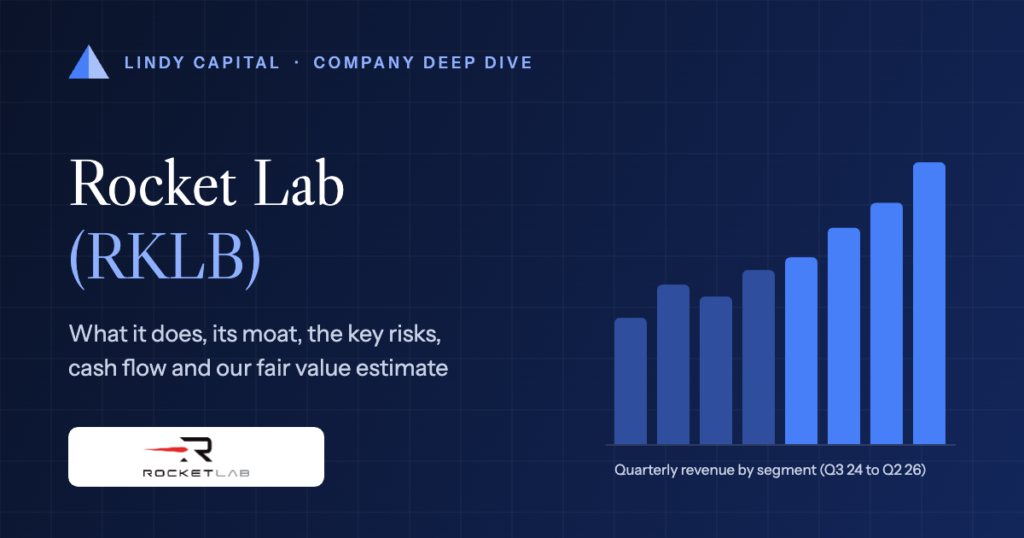
Quarterly figures show where growth is coming from. Space Systems revenue roughly doubled from US$97.9 million in the June 2025 quarter to US$189.5 million a year later, helped by satellite programmes for the US government and recent acquisitions.
Launch revenue is lumpier because it depends on how many rockets fly in a quarter. It peaked at US$75.9 million in the December 2025 quarter, then fell to US$44.6 million in June 2026, slightly below a year earlier. Rocket Lab flew 21 Electron and HASTE missions in 2025.
The backlog (contracted work not yet delivered) is the best guide to what comes next. It rose from US$1.10 billion at 30 September 2025 to US$1.85 billion at year end and US$2.36 billion at 30 June 2026. About 45% is expected to turn into revenue within 12 months.
Quarterly revenue by segment
US$ millions; Launch Services and Space Systems
Series: Launch Services, Space Systems. Source: Rocket Lab Forms 10-Q (Q3 2025, Q2 2026). Q4 24, Q4 25 and Q1 26 are derived by subtracting reported nine-month or six-month totals from full-year (StockAnalysis segment data) or half-year figures.
View the data
| Launch Services | Space Systems | |
|---|---|---|
| Q3 24 | 21 | 84 |
| Q4 24 | 42 | 90 |
| Q1 25 | 36 | 87 |
| Q2 25 | 47 | 98 |
| Q3 25 | 41 | 114 |
| Q4 25 | 76 | 104 |
| Q1 26 | 64 | 137 |
| Q2 26 | 45 | 190 |
How Rocket Lab makes money
Launch fees. Customers pay per mission to put a satellite in orbit on Electron or to fly a suborbital test on HASTE. Electron is a dedicated ride, so customers choose the orbit and timing, which supports a higher price per kilogram than sharing a larger rocket.
Building satellites. Rocket Lab is prime contractor on large multi-year satellite contracts, including a US$515 million US government constellation award in 2024 and, in 2026, a US$397 million Space Force contract for spacecraft to launch on Neutron. Revenue is recognised as the work progresses.
Selling components. Solar cells and panels, reaction wheels, star trackers, separation systems, radios and laser communication terminals are sold to other spacecraft makers. This is Rocket Lab’s broadest customer base.
Government work. About 47% of 2025 revenue came from US government-related sources, up from 33% in 2024. One government customer accounted for 42% of revenue in the first half of 2026.
The moat: where the advantage comes from
Rocket Lab’s advantage comes from being one of very few companies that has proved it can reach orbit repeatedly, and from owning most of the parts that go into a satellite. Both are hard and slow to copy, but neither is yet protected by profits.
Sources of competitive advantage
Our assessment of which classic moat sources apply to Rocket Lab
| Moat source | Applies? | Where it shows up |
|---|---|---|
| Switching costs | Partial | Constellation customers design around a supplier’s spacecraft bus and components; changing mid-programme is costly |
| Intangible assets | Partial | Flight heritage of 75+ successful Electron missions, US security clearances and launch licences |
| Network effects | Limited | Little sign of the business getting more valuable as more customers join |
| Cost advantage and scale | Limited | Vertical integration helps, but SpaceX’s reusable rockets set far lower costs per kilogram |
| Efficient scale | Partial | Few credible small launchers and satellite primes exist for US defence work |
The moat is real but narrow. Its strongest part is reliability and track record in a market where many rivals have failed to reach orbit. Its weakest point is cost: until Neutron flies and is reused, Rocket Lab cannot match SpaceX on price for most payloads.
Customers and competition
Rocket Lab competes on two fronts: against launch providers for rides to orbit, and against established aerospace firms and start-ups for satellite and component work.
- SpaceX dominates launch with reusable Falcon 9 rockets and sells cheap shared rides that undercut small rockets for customers who can accept a fixed schedule. It also builds its own Starlink satellites.
- Firefly Aerospace offers the Alpha small rocket, is developing the Eclipse medium rocket that would compete with Neutron, and builds the Blue Ghost lunar lander.
- Traditional defence primes and satellite makers compete for US government constellation contracts and in components.
How Rocket Lab compares with its peers
We compare Rocket Lab with SpaceX, the dominant launch company and a listed company since June 2026, and Firefly Aerospace, the closest like-for-like listed rival with both rockets and spacecraft. Both have real revenue, and together they bracket Rocket Lab’s position by size.
Rocket Lab against its closest listed peers
Figures at the close on 19 October 2026. GAAP margins unless stated; forward P/E uses analysts’ next-year earnings estimates.
| Measure | Rocket Lab RKLB | SpaceX SPCX | Firefly Aerospace FLY |
|---|---|---|---|
| Market value | US$30.7B | US$2.01T | US$2.8B |
| Revenue, last 12 months | US$769.2M | US$23.0B | US$287.0M |
| Gross margin | 37.3% | 51.9% | 22.9% |
| Operating margin (GAAP) | -27.6% | -14.9% | -106.1% |
| Free cash flow margin | -48.3% | -141.1% | -113.8% |
| Return on invested capital | -5.5% | n/a | -25.4% |
| Net cash (net debt) | US$2.25B | US$60.3B | US$581.9M |
| Forward P/E | Not meaningful (3,003x) | 93.3x | n/a |
| PEG ratio | n/a | n/a | n/a |
| Dividend yield | None | None | None |
Valuation multiples and market values move with share prices and are shown at the date above. Source: StockAnalysis unless stated.
All three lose money on a GAAP operating basis. Rocket Lab’s operating loss as a share of revenue is smaller than Firefly’s but larger than SpaceX’s, and a higher gross margin than Firefly but lower than SpaceX. Rocket Lab’s free cash flow margin of -48.3% is the least negative of the three, though SpaceX is spending heavily on a far larger base. Free cash flow margins for Rocket Lab, SpaceX and Firefly are our calculations from StockAnalysis free cash flow and revenue.
Durability: the Lindy test
The Lindy effect says the longer something has survived, the longer it is likely to keep surviving. Rocket Lab is 20 years old, has been listed for about five, and reached orbit for the first time in 2018. That is young for an aerospace business, and it scores accordingly.
Key moments in Rocket Lab’s history
- 2006 · Peter Beck founds Rocket Lab in Auckland, New Zealand.
- 2009 · The Ātea-1 sounding rocket reaches space, a first for a private company in the Southern Hemisphere.
- 2018 · Electron reaches orbit on its second flight, after a first flight in 2017 that failed.
- 2020 · Headquarters moves to Long Beach, California; the first Photon spacecraft flies; an Electron failure loses customer payloads.
- 2021 · Lists on Nasdaq through a SPAC merger; announces Neutron; a second Electron failure.
- 2022 · Buys SolAero; the CAPSTONE mission reaches lunar orbit with help from Photon.
- 2023 · First HASTE mission; a third Electron failure; a record 10 Electron flights that year.
- 2025 · Rocket Lab Corporation becomes the listed parent; Geost acquired; 21 missions flown with 100% success.
- 2026 · Mynaric and Motiv acquired; Iridium deal agreed; Neutron’s first launch moved to 2027.
Three launch failures in 2020, 2021 and 2023 were each followed by a return to flight, which is a sign of resilience. But the business has never earned an annual profit and its next stage depends on a rocket that has not yet flown, so on the Lindy test it remains early.
Profitability and cash flow
Gross margin, what is left after the direct cost of products and services, improved from 32.1% in the June 2025 quarter to 36.1% a year later. Guidance for the September 2026 quarter is lower, at 29% to 31%, as new programmes ramp.
Operating losses have barely shrunk in dollars: US$57.5 million in the June 2026 quarter against US$59.6 million a year earlier, because research and development on Neutron and new programmes keeps rising. The company is near breakeven on adjusted EBITDA, a measure that excludes share-based pay and other items, at a loss of US$8.8 million for the quarter.
Free cash flow, operating cash flow less capital spending, has been negative every year. It was -US$321.8 million in 2025 and -US$187.5 million in the first half of 2026.
Annual free cash flow
US$ millions
US$ millions. Source: StockAnalysis cash flow statement; operating cash flow less capital expenditures.
View the data
| Value | |
|---|---|
| FY21 | −98 |
| FY22 | −149 |
| FY23 | −154 |
| FY24 | −116 |
| FY25 | −322 |
| TTM Jun 26 | −371 |
Losses are partly a choice: the company is funding Neutron and new launch sites. The test is whether margins rise once Neutron is flying and the large satellite contracts mature.
Financial health: debt and cash
At 30 June 2026 Rocket Lab held US$2.13 billion in cash plus US$258.1 million in marketable securities, about US$2.39 billion in total. Convertible notes on the balance sheet fell from US$152.4 million at the end of 2025 to US$13.1 million, plus US$1.7 million of other borrowings.
StockAnalysis puts net cash, after leases and other debt, at US$2.25 billion. That cash came largely from selling new shares: about US$1.53 billion was raised through at-the-market share sales in the first half of 2026.
The balance sheet is strong for today, but it will change if the Iridium deal closes. Rocket Lab has committed financing for a US$3.6 billion bridge loan to fund the cash part of the purchase, which would turn a net cash position into meaningful debt.
Capital allocation and management
Peter Beck founded the company and still leads it as chief executive and chairman, which gives continuity and a clear engineering culture. The flip side is a long record of ambitious timelines: Neutron was once planned for 2025 and is now expected in 2027.
Management has used its highly valued shares as currency, raising cash through share sales and buying a string of component makers. The share count rose from 543.6 million common shares at the end of 2025 to 598.2 million at 30 June 2026. The Iridium deal, at US$27 cash plus Rocket Lab shares for each Iridium share, is the largest step yet and would add both debt and further dilution.
Strengths and risks at a glance
What stands out
Our checklist of the business’s main strengths and risks
Strengths
- Proven launch record: more than 75 successful Electron missions and 21 missions in 2025 without a failure.
- Record backlog of US$2.36 billion at 30 June 2026, up 137% on a year earlier.
- Vertical integration across rockets, spacecraft and components.
- Net cash of about US$2.25 billion to fund development.
- Deep ties with US government and defence customers, with HASTE serving hypersonic testing.
Risks
- Neutron has slipped again, to 2027, after a tank problem; further delays would push out the growth case.
- No annual profit to date and negative free cash flow every year.
- Heavy reliance on US government spending; one customer was 42% of first-half 2026 revenue.
- The Iridium deal would add a US$3.6 billion bridge loan, new shares and integration risk.
- SpaceX’s scale and reusable rockets set the price for much of the market.
The case for and against the business
Both sides
The strongest arguments we can make each way about the business
The case for
Rocket Lab has done what most launch start-ups could not: it reaches orbit reliably and has built a satellite and component business that now earns most of its revenue. Backlog more than doubled in a year, gross margins have improved, and the company has the cash to finish Neutron. If Neutron works and is reused, Rocket Lab could become the main US alternative to SpaceX for medium payloads, with Iridium adding recurring service revenue.
The case against
The company is still losing money and burning cash, and its growth story depends on a rocket that has been delayed repeatedly. Much of its revenue comes from one government customer and from acquisitions funded with dilutive share sales. The Iridium deal adds debt and complexity at the same time Neutron is unproven, and SpaceX remains far larger and cheaper.
Our fair value estimate for Rocket Lab
Because Rocket Lab is not profitable, we value it on enterprise value to sales: the value of the operating business as a multiple of revenue. We take analysts’ 2027 revenue estimate of US$1.33 billion (StockAnalysis), apply a haircut for Neutron and execution risk, multiply by a sales multiple, add net cash we expect at the end of 2027 after further cash burn, divide by about 641 million shares (including preferred stock) and discount back 1.2 years at 12% a year. We value Rocket Lab on its own and leave the Iridium deal out, since it has not closed.
Our base case uses US$1.20 billion of 2027 revenue (a 10% haircut), 12 times sales and US$1.85 billion of net cash, giving about US$22 a share today. The bear case gives about US$10 and the bull case about US$48, against a share price of US$51.36. The current price implies a sales multiple well above our bull case; this is our estimate and may prove wrong.
Lindy Capital fair value estimate · Rocket Lab Corporation
Overvalued on our estimate
The share price is 142% above our fair value estimate. Shaded bands sit 20% either side of our base-case estimate; the striped strip shows the range of our scenarios.
| Scenario | FY2027 revenue | EV/sales applied | Fair value today |
|---|---|---|---|
| Bear: 25% haircut, US$1.45B net cash, 680M shares | US$1.00B | 6x | US$9.56 |
| Base: 10% haircut, US$1.85B net cash, 641M shares | US$1.20B | 12x | US$22.13 |
| Bull: consensus, US$2.05B net cash, 641M shares | US$1.33B | 25x | US$48.07 |
Fair value = (FY2027 revenue × EV/sales + expected net cash at end-2027) ÷ shares, discounted 1.2 years at 12%; revenue anchor is StockAnalysis consensus, net cash starts from US$2.25B at 30 June 2026.
Two traps when valuing Rocket Lab
Trailing sales multiples flatter the future. At about 37 times trailing sales, the price already assumes years of fast growth and a working Neutron. A slip in either can compress the multiple quickly, as the fall from a 52-week high of about US$151 shows.
The share count is a moving target. Share sales, conversions and the stock portion of the Iridium deal (up to 0.4 Rocket Lab shares per Iridium share) can all raise the share count, so per-share value can fall even if the business grows.
Share price vs our fair value estimate
Weekly closing price over two years, with each fair value estimate from the date we published it. The shaded band is our bear-to-bull range.
First estimate published 5 November 2026. The dashed line shows the estimate in force; until we revise it, it is drawn across the whole period for comparison. Latest weekly price US$53.60. Prices from Yahoo Finance, refreshed daily. The estimate changes only when we revise it.
What we would watch
- A firm date for Neutron’s first launch and its outcome.
- Progress on the Iridium deal: regulatory approvals, final financing and share issuance.
- Gross margin against the 29% to 31% GAAP guidance for the September 2026 quarter.
- Backlog growth and how much converts to revenue within 12 months.
- Free cash flow and any further share sales.
The short version
Rocket Lab is a real, growing space business with a proven small rocket, a fast-growing satellite arm and a strong cash position. It is also young, unprofitable and dependent on a delayed rocket and a large pending acquisition. Our base-case fair value of about US$22 a share is well below the current price, which reflects how much success the market already assumes. It is an opinion, not advice.
Frequently asked questions
What does Rocket Lab do?
It launches small satellites on its Electron rocket, flies suborbital tests on HASTE, and builds satellites and spacecraft components. Space Systems supplied 81% of revenue in the June 2026 quarter.
Is Rocket Lab profitable?
No. It reported a net loss of US$165.5 million over the 12 months to 30 June 2026 and has had negative free cash flow every year since listing.
When will Neutron launch?
On 14 October 2026 Rocket Lab said Neutron’s first launch is now expected in 2027, later than its previous target of the fourth quarter of 2026.
Why is Rocket Lab buying Iridium?
Iridium operates a global satellite communications network. The deal, valued at about US$8 billion including debt, would add recurring service revenue and spectrum. It is expected to close in 2027, subject to approvals.
Is Rocket Lab a buy?
We don’t make buy or sell recommendations. Our fair value estimate, set out above with its assumptions, is our opinion of what the business may be worth, not advice. Whether any investment suits you depends on your own circumstances, so speak to a licensed financial adviser.
Sources
- Rocket Lab Q2 2026 earnings release (8-K Ex. 99.1)
- Rocket Lab Form 10-Q, quarter ended 30 June 2026
- Rocket Lab Form 10-Q, quarter ended 30 September 2025
- Rocket Lab Form 10-K, FY2025
- Rocket Lab Q3 2025 earnings release
- Rocket Lab Q4 and FY2025 results
- Rocket Lab Iridium merger 8-K (28 June 2026)
- Rocket Lab Neutron update (14 October 2026)
- Light Reading: Neutron launch delayed to 2027
- DCD: Rocket Lab acquires Iridium in US$8bn deal
- TIKR: Why Rocket Lab stock is down from its highs
- StockAnalysis RKLB statistics
- StockAnalysis RKLB forecast
- StockAnalysis RKLB income statement
- StockAnalysis RKLB cash flow
- StockAnalysis RKLB revenue by segment
- StockAnalysis SPCX statistics
- StockAnalysis SPCX profile
- StockAnalysis FLY statistics
- StockAnalysis FLY profile
- Wikipedia: Rocket Lab (history)
Disclosure: Lindy Capital may hold, buy or sell shares in Rocket Lab (RKLB) at any time, without notice, and does not disclose its positions. This is a study of how a business works, not a recommendation to buy, sell or hold any security. Our fair value estimate is an opinion based on the assumptions stated with it, not a price target or a forecast of the share price. Company guidance and analysts’ estimates are shown as reported. Figures are from public filings and data providers and will date. Important information.